
MP-FCIF ; A WEB BASED BUG REPORT
Turning a Bug Report Into a Web-Based Documentation Platform
A real Figma vulnerability, disclosed as a permanent, linkable site instead of a one-off PDF.
- Project:
- MP-FCIF — Web-Based Bug Report
- Role:
- Design & Development (solo)
- Tech Stack:
- Framer & Figma
- Project Start:
- May 2025
- Duration:
- Approx. 3 weeks, start to launch
Where This Started
I found a real vulnerability in Figma. Their access control had a hole in it — Starter plan users could bypass the platform's page-creation limits inside collaborative files. Something that's supposed to be locked behind a paid plan, wide open for free. A solid find, the kind you'd normally write up and send off.
But when it came time to actually document it, I ran into the same wall every bug hunter runs into: the format. Every bug report I'd ever seen — mine included — lived and died as a PDF. Static, unlinkable, forgettable the second it leaves someone's downloads folder.
So instead of writing another PDF, I asked myself a different question: what if a bug report looked like actual documentation? Searchable, versioned, something you send as a link instead of an attachment.
Why Bother?
Nobody in the security research space was doing this. Every disclosure I'd come across — including my own past ones — existed as a one-off file with no home, no version history, and no way to browse someone's past work as a body of research rather than a scattered pile of PDFs.
So the goal stopped being "document one bug" and became "build a format I can actually reuse." Something structured enough to feel credible, simple enough that I'd actually want to publish the next one in it too.
Building MP-FCIF
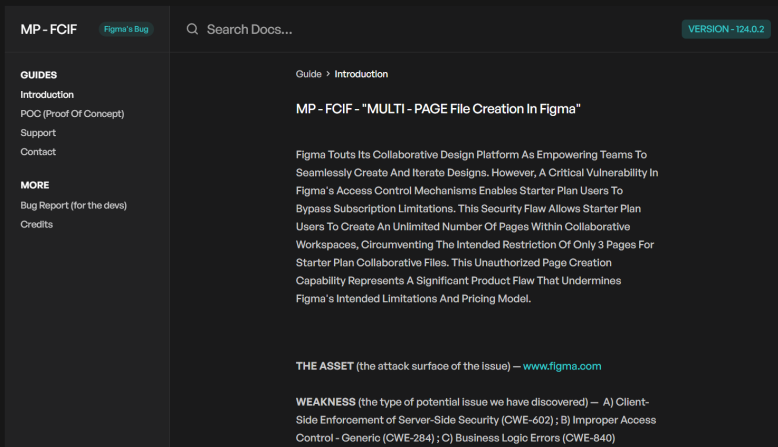
Built the whole thing in Framer. Instead of a report, I structured it like a documentation site — a persistent sidebar, a version tag pinned to the corner, and content split cleanly between the narrative writeup and the technical breakdown.
- A Guides sidebar — Introduction, Proof of Concept, Support, Contact — so it reads like any product's help docs, not a wall of text
- A structured technical section — asset, weakness classification with CWE references, impact — broken into labeled parts instead of one long paragraph
- Version tracking in the header, so I can update the report without killing the original link or starting over from scratch
- A proof-of-concept page with actual reproduction steps, laid out step by step like real technical documentation
- A short video walkthrough embedded directly in the docs, for anyone who'd rather watch the exploit than read it
What Made This Hard
Building it in Framer wasn't the hard part. The hard part was that there was no template for "a bug report, but as a website" to lean on — because as far as I could find, nobody had actually built one this way before. Every call — how much technical detail goes above the fold, how to classify severity without it reading like a corporate security advisory, how to keep it readable for a non-technical reader and useful for a developer scanning for a CWE code — I had to figure out from zero.
Tone was its own problem. The whole point of moving off a PDF was to make the thing more approachable and shareable — but I didn't want it tipping into either an overly clinical advisory or a casual blog post. Landed on a dark, documentation-style layout with clearly labeled sections: structured enough to feel credible, simple enough to actually finish reading.
Where It Landed
MP-FCIF went live as a real, linkable, versioned alternative to a static PDF disclosure — the first one I'd built or seen done this way. Instead of a file that gets buried in someone's inbox, it's a site you can send as a link, update without losing the trail, and actually point people back to.
The bigger win wasn't the one bug report — it was the format. I've now got a reusable structure for every future disclosure, which turns a single writeup into the start of an actual, ongoing body of published work instead of a one-off PDF nobody remembers.
Written by Yasir
Fiverr username @yasir_page
CASE STUDY 003