
FORGE ; A CNC MANUFACTURING WEBSITE
Making a CNC Machine Shop Feel as Fast as the Parts It Ships
A product-first website for a precision manufacturer, built in 2025 — upload a CAD file, get parts tomorrow.
- Project:
- Forge — Precision CNC Manufacturing Website
- Role:
- Design & Development (solo)
- Tech Stack:
- Framer, Figma & AI-assisted 3D renders
- Project Start:
- 2025
- Duration:
- Approx. 4 weeks, start to launch
Where This Started
Forge is a CNC machining company out of Montreal with more than twelve years of delivering precision parts and over 100,000 parts manufactured every year. The work was world-class. The website was not — it read like a brochure from a decade ago, with nothing that showed how fast and how precise the shop actually is.
Manufacturing buyers — engineers, hardware startups, product teams — don't browse. They land with a CAD file and one question: can you make this, how well, and how soon? The old site made them dig for every one of those answers.
So the brief became simple: build a site where the product does the talking, and where the path from "I have a design" to "it's in production" takes one click.
Why Bother?
Most machine shop websites look identical — stock photos of a lathe, a phone number, and a "request a quote" form that disappears into an inbox. They sell capacity, not confidence.
Forge's real advantage is speed and precision, and neither of those come through in a stock photo. The goal was to make the website itself feel precise — tight typography, clean white space, and parts that look engineered down to the last chamfer.
Building Forge
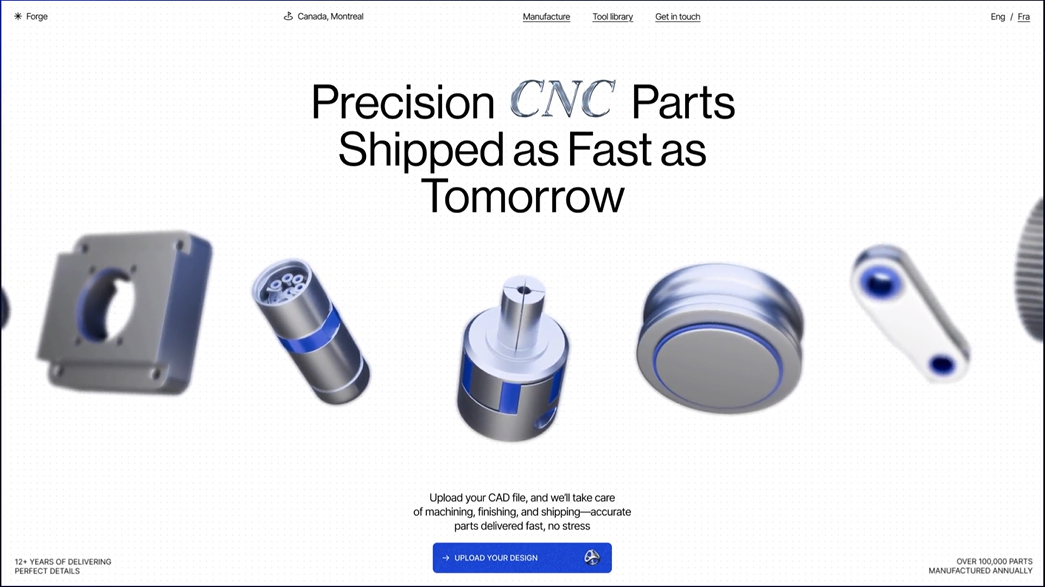
Designed in Figma and built in Framer, with the hero carried by a row of floating, slowly rotating CNC parts — shafts, couplings, caps, and brackets — rendered in brushed aluminium with Forge's signature blue accents. AI-assisted 3D rendering made it possible to produce a full set of studio-quality part renders without a single product photoshoot.
- A hero headline that states the promise outright — "Precision CNC Parts Shipped as Fast as Tomorrow" — with the key proof points, 12+ years and 100,000+ parts a year, pinned to the corners
- A single primary action, "Upload Your Design", so the buyer's first click is the start of an order rather than a contact form
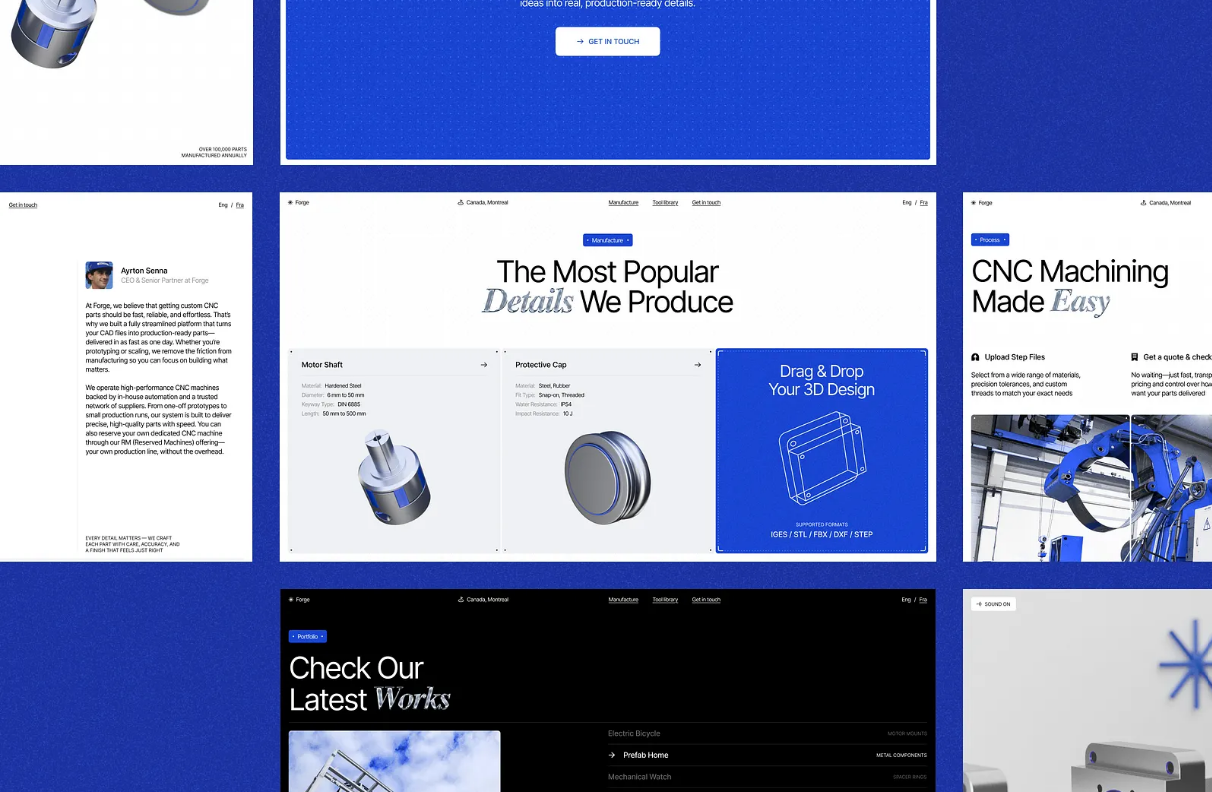
- A "Most Popular Details We Produce" catalog with real specs per part — material, diameter, keyway type, fit type, resistance ratings
- A drag-and-drop 3D upload zone supporting IGES, STL, FBX, DXF and STEP files
- A three-step "CNC Machining Made Easy" process section — upload, get a quote, receive your parts
- A founder note from the CEO, a dark-mode portfolio of recent works, and full English / French language switching for the Canadian market
The Rest of the Site
Every section below the fold follows the same rule as the hero: one idea per screen. The catalog shows specs instead of adjectives, the process section removes any guesswork about what happens after upload, and the founder note puts a real human behind the machines.
The blue-and-white system carries across every page, switching to a dark layout only for the portfolio, where the finished parts need to stand out the most.
What Made This Hard
The hardest part was making heavy industry feel light. Manufacturing sites tend to drift toward either cold and technical or overly slick and vague. Forge needed to feel precise enough for an engineer to trust the tolerances, but approachable enough that a founder with their first prototype wouldn't feel out of place.
The 3D parts were their own challenge. Every render had to look physically correct — real machined surfaces, believable reflections, accurate proportions — because an engineer will notice a part that couldn't actually be manufactured. Each render went through several passes before it made it onto the page.
Where It Landed
Forge launched in 2025 with a website that finally matches the quality of its parts — a product-first experience where a buyer can go from landing on the page to uploading a CAD file in a single click.
The bigger win was positioning. Forge no longer looks like a local machine shop; it looks like a modern manufacturing platform that happens to own the machines.
Written by Yasir
Fiverr username @yasir_page
CASE STUDY 005